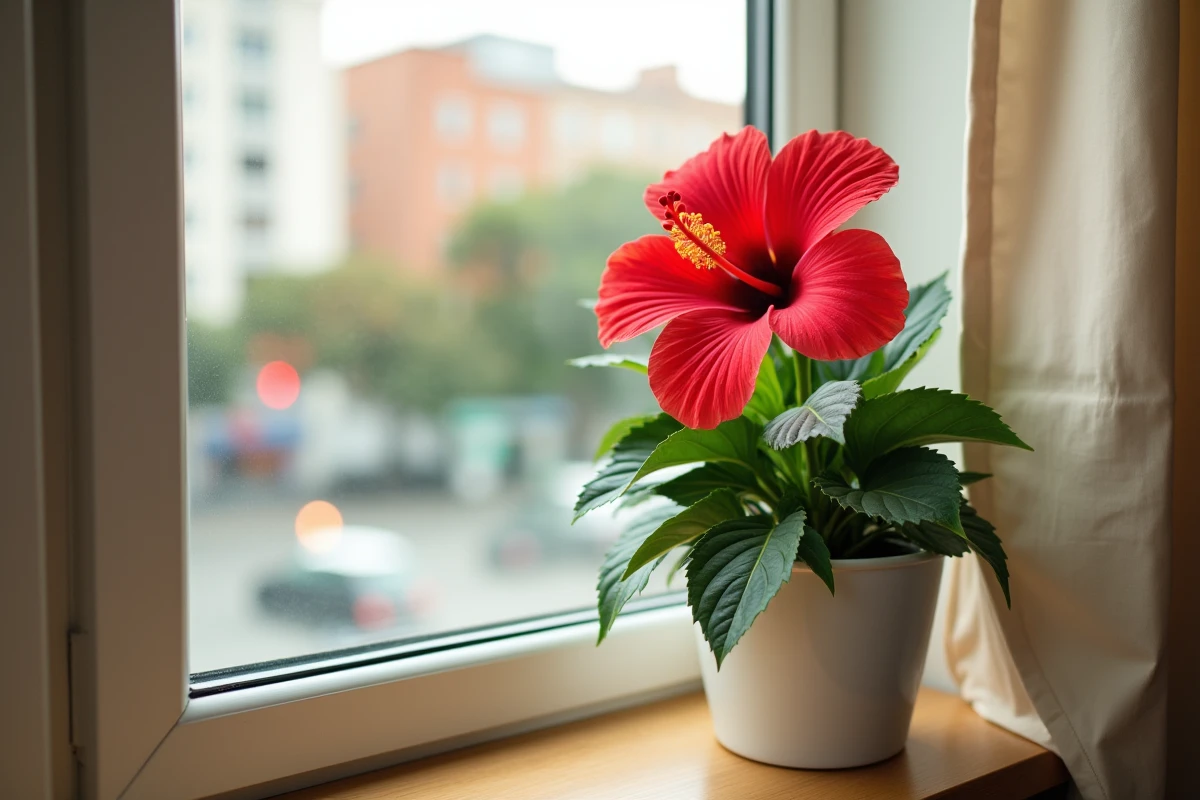
You just acquired a hibiscus from a garden center or a friend, and the label has disappeared. Knowing whether it is an indoor or outdoor hibiscus makes all the difference: the wrong placement can kill it in a few weeks. Two main species share the shelves, Hibiscus rosa-sinensis (indoor) and Hibiscus syriacus (outdoor), but a third, lesser-known species complicates matters.
Swamp Hibiscus: the third type that confuses the diagnosis
Most guides only compare rosa-sinensis and syriacus. However, garden centers are increasingly selling Hibiscus moscheutos, known as “swamp hibiscus.” This hardy perennial produces giant flowers, sometimes wider than an open hand, which resemble more of an indoor tropical plant than a garden plant.
The trap is real. With its soft petals and bright colors, the swamp hibiscus looks like an oversized rosa-sinensis. However, it is a frost-resistant perennial in temperate climates, whose aerial part disappears in winter before regrowing from the base in spring.
Before trying to distinguish between indoor and outdoor, check if your plant has unusually large flowers and herbaceous stems rather than woody ones. If so, you probably have a moscheutos, and its place is in the garden, in cool soil.
Leaves and growth habit: visual clues that differentiate rosa-sinensis and syriacus
You have ruled out the swamp hibiscus. Now, you need to distinguish between the two most common species. The first reflex is to observe the leaves, not the flowers.
To recognize an indoor or outdoor hibiscus, start by touching the foliage. Hibiscus rosa-sinensis (indoor) has dark green, shiny, and smooth leaves with a serrated edge. They remain on the plant all year if conditions are suitable.
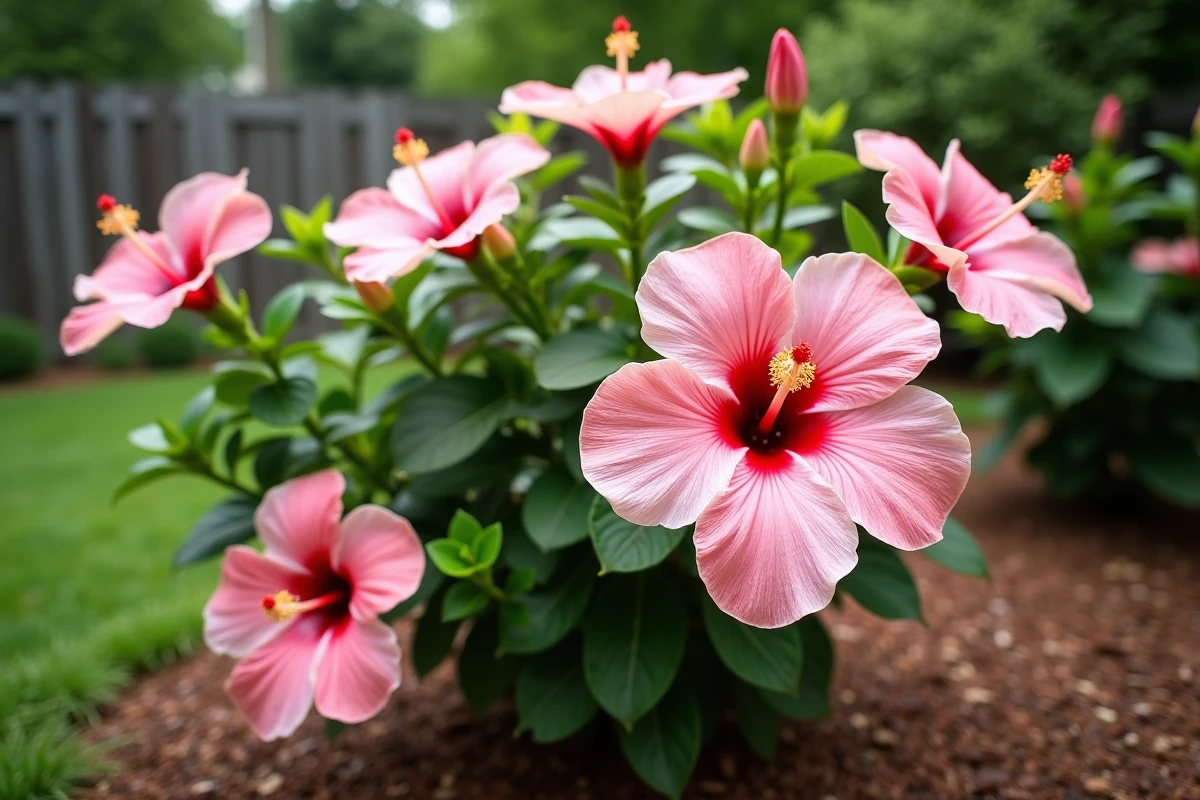
Hibiscus syriacus (outdoor, also called althaea) has deciduous foliage, more matte, with often lobed leaves. When touched, the surface is slightly rough. In autumn, its leaves fall, which rosa-sinensis never does spontaneously in a heated indoor environment.
The growth habit of the plant provides a second reliable clue:
- Rosa-sinensis grows as a compact shrub with soft stems, rarely exceeding one meter in a pot. Its bark remains green or slightly brown.
- Syriacus develops a upright habit with woody and rigid branches, capable of reaching several meters in the ground. Its bark turns gray with age.
- Remember, moscheutos forms unbranched herbaceous stems that are almost upright, which dry completely as winter approaches.
Cold hardiness test: the most reliable criterion when visuals are not enough
Some modern hybrids complicate visual identification. Breeders cross varieties, resulting in intermediate foliage. In this case, cold tolerance becomes the decisive criterion.
Hibiscus rosa-sinensis dies as soon as the temperature approaches 5 °C. If your plant has spent a winter outside without protection in a region where it freezes, you can rule out this species. A rosa-sinensis simply would not have survived.
In contrast, Hibiscus syriacus tolerates very low temperatures, often cited around -15 to -20 °C according to horticultural sources. It loses its leaves, appears dead for several months, then regrows in spring. This cycle is normal and does not mean the plant is suffering.
How to use this criterion without waiting for winter
You received your hibiscus in summer and cannot wait until January to decide. Two clues help guess its hardiness without putting it in danger.
Look at the substrate. A rosa-sinensis sold in a garden center comes in a light, peat-based potting mix, typical for indoor plants. A syriacus is often packaged in a container with a denser mix, sometimes mixed with garden soil.
Examine the label or the pot’s barcode. Even if the descriptive label has disappeared, the barcode allows you to find the product sheet online. This is often the quickest way to clear up any doubts.
Flowering of indoor hibiscus compared to outdoor
The flowers provide a final level of confirmation, as long as you know what to observe beyond the color.
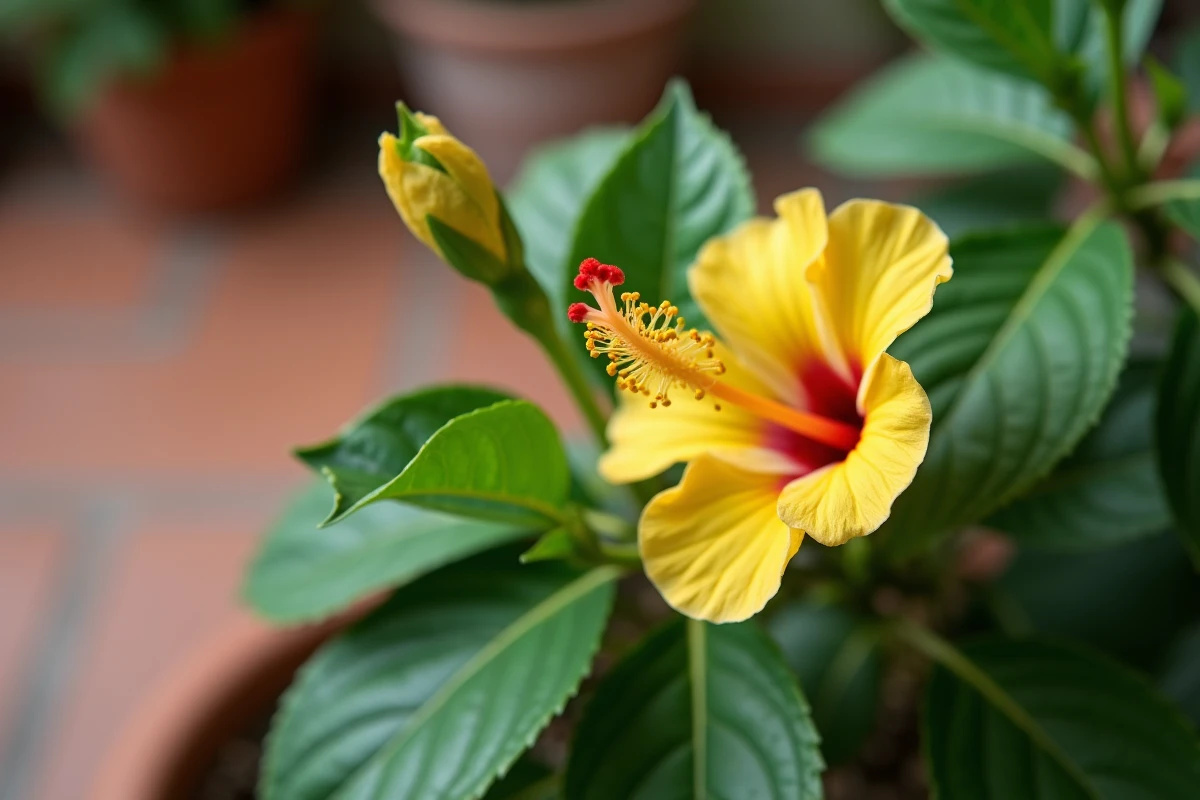
The flowers of rosa-sinensis are often solitary, borne on a long pistil that clearly extends beyond the corolla. They rarely last more than a day or two, but continuously renew from May to October, sometimes all year if the light is sufficient.
Those of syriacus resemble small hollyhocks. They are smaller, often double, and appear in clusters along the branches of the year. The flowering is concentrated in summer, from July to around September, then stops sharply in autumn.
Have you noticed that your hibiscus is still blooming in November on a heated windowsill? It is a rosa-sinensis. A potted syriacus would have already lost its leaves by this time, regardless of the ambient temperature. This seasonal behavior is genetically encoded and does not depend on heating.
When flowers are absent
A stressed hibiscus (lack of light, excess water, recent repotting) may refuse to bloom for months. The absence of flowers does not help with identification. Return to the leaf criteria and substrate test, which remain usable all year round.
The distinction between indoor and outdoor hibiscus relies on a combination of signals: leaf texture, substrate type, winter behavior, and flower shape. No single criterion guarantees a diagnosis, but crossing two or three clues provides a reliable answer.
If doubt remains, keep the plant indoors near a bright window the first winter: a rosa-sinensis will thrive there, while a syriacus will show signs of dormancy despite the warmth.