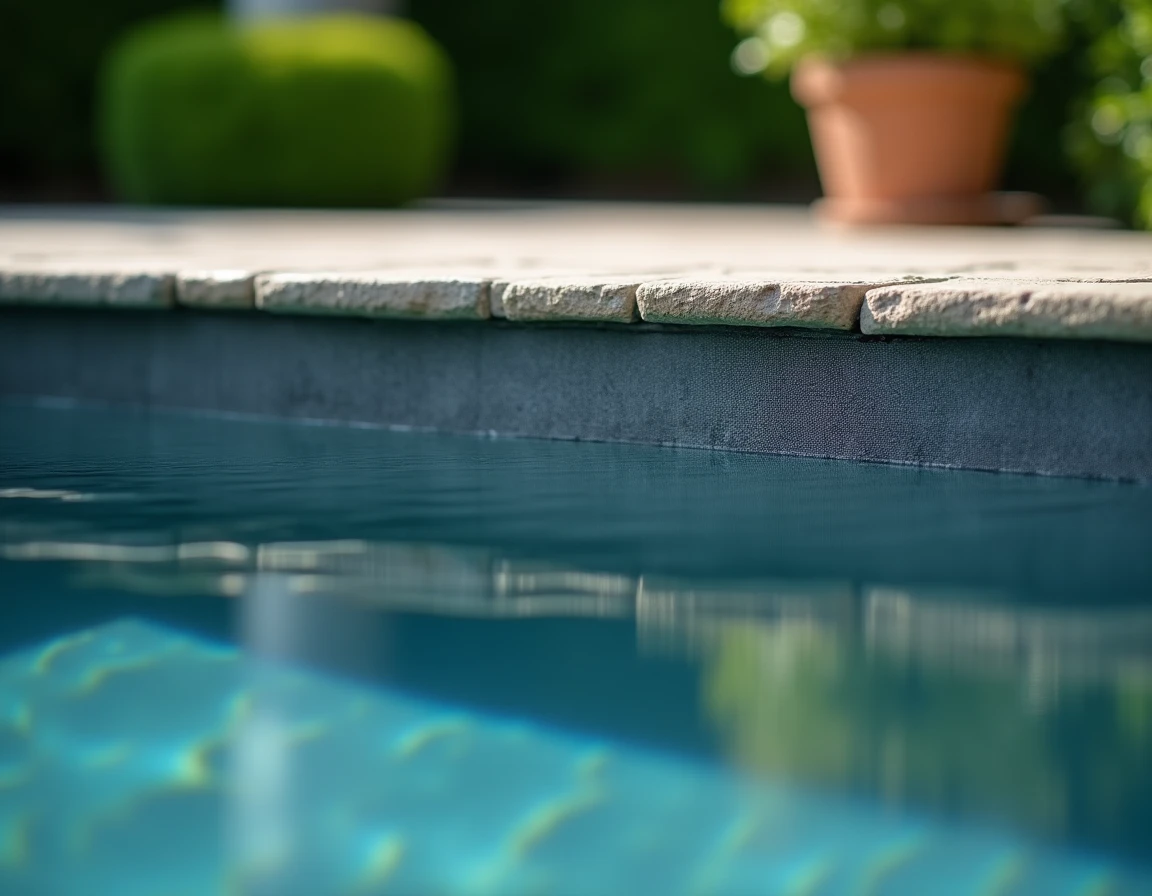
The anthracite gray liner gives the water a dark and deep reflection that is alluring, but this dark shade also exposes every mark of discoloration much more visibly than a light blue or sand liner. To understand how to protect this coating, one must first identify what attacks it: the aggressions do not all come from the same source, and the responses vary depending on the type of pool and the treatment method.
Factors of discoloration of the anthracite gray liner: comparison of causes and their impact
All pool owners vaguely know that chlorine and the sun damage the liner. The reality is more nuanced. Some causes lead to uniform discoloration, while others cause localized marbling, and the solutions vary radically from case to case.
| Cause | Type of discoloration | Affected area | Reversibility |
|---|---|---|---|
| Localized over-chlorination (tablet placed on the bottom, undiluted shock chlorine) | Localized white spot | Bottom, lower walls | Irreversible |
| Recurring concentrated chlorine (manual dosing without regulation) | Diffuse light marbling | Entire pool | Irreversible |
| Prolonged UV and solar radiation | Uniform fading | Bottom and exposed areas | Very slow, partially maskable |
| Unbalanced pH (below 7 or above 7.6) | Dulling, loss of shine | Waterline, walls | Stabilizable if corrected quickly |
| Moisture rising behind the liner (old support, concrete/tile) | Irregular light halos | Walls, sloped bottom | Irreversible without replacement |
On an anthracite gray liner, the light marbling due to concentrated chlorine is the most reported problem. Customer service feedback compiled by several pool networks between 2021 and 2024 confirms that this phenomenon affects dark liners installed during renovations on old tiled pools, especially when the support has not been properly insulated from moisture.
To better avoid discoloration of the anthracite gray liner, it is necessary to address several of these causes simultaneously, not just the chlorine level.
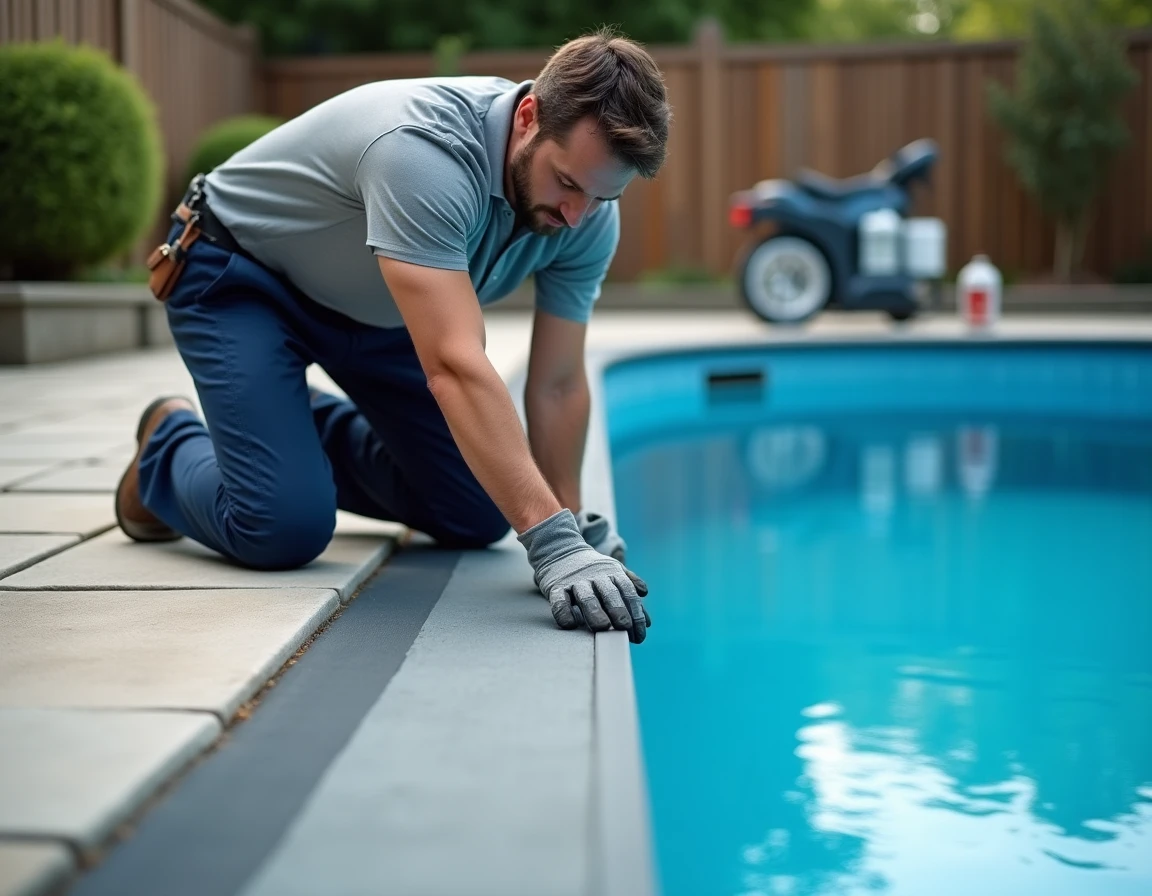
Chlorine and dark liner: why manual dosing is problematic
Most guides simply recommend not to “overdose chlorine.” This wording masks the true mechanism. On an anthracite gray liner, it is not so much the total amount of chlorine that causes discoloration, but the local concentration at the moment of contact.
A slow-release chlorine tablet placed in a skimmer without a diffuser basket, or worse, placed directly on the bottom of the pool, creates a very concentrated chlorine cloud at the point of contact. On a light liner, the stain goes almost unnoticed. On an anthracite gray liner, it forms a definitive white circle in a few hours.
Fractional dosing or automatic regulation
The Federation of Pool Professionals (FPP) recommends in its technical sheets revised between 2022 and 2024 to prefer fractional dosing or automatic systems (salt electrolyzer, dosing pump with probe) for pools with dark coatings. The goal: to eliminate concentration peaks that cause marbling.
- The salt electrolysis produces chlorine continuously at low doses, which avoids “clouds” of concentrated product coming into contact with the liner
- A dosing pump coupled with an ORP probe adjusts the injection in real-time according to the actual demand of the water
- Treatment with bromine or active oxygen, which is less aggressive on pigments, is an alternative for small volumes
With manual dosing, there is no zero-risk. Each addition of powdered or tablet chlorine represents a local concentration peak, even with good prior dilution in a bucket of water.
Installation support and moisture migration: the ignored factor
Consumer articles focus on water and UV. They overlook a cause of discoloration specific to renovations: moisture rising between the support and the liner.
When an anthracite gray liner is installed over an old raw concrete pool or existing tiles, water can migrate by capillarity behind the membrane. This trapped moisture creates irregular light halos that do not correspond to any water treatment defect. The owner corrects their pH, adjusts their chlorine, scrubs the waterline, and the stains persist.
Preparation of the support before installation
For a new pool, the problem rarely arises if the slab and walls are properly coated. However, in a renovation, the interposition of a protective geotextile felt between the old support and the liner is the only effective barrier against these migrations. The felt absorbs micro-rises without allowing stagnant water to come into direct contact with the back of the PVC.
Without this precaution, the manufacturer’s warranty on color retention may be called into question. Technical documents from manufacturers like Alkorplan/RENOLIT specify that the conformity of the support conditions the validity of the discoloration warranty.
Regular maintenance of the anthracite gray liner: pH, coverage, and cleaning
Beyond chlorine and the support, three maintenance parameters directly influence the longevity of the anthracite shade.
The pH must remain between 7.2 and 7.4 for chlorine treatment. A pH that is too low (below 7) makes free chlorine more aggressive and accelerates the attack on pigments. A pH that is too high promotes the deposition of lime, which, on a dark bottom, forms a whitish veil often mistaken for discoloration.
Covering the pool outside of swimming periods (safety cover, roller shutter, shelter) significantly reduces exposure to UV. On a dark liner, every hour of solar exposure without protection accelerates fading. Pools covered by a submerged roller shutter or a low shelter retain their anthracite shade much longer than uncovered pools throughout the season.
Mechanical cleaning also matters. A pool robot with soft brushes (foam or soft PVC) cleans without scratching the surface of the liner. Hard bristle brushes or metal scrapers create micro-scratches that trap lime and give a localized whitened appearance.
The discoloration of an anthracite gray liner rarely results from a single cause. It is the combination of poorly dosed chlorine, poorly prepared support, and uncontrolled solar exposure that leads to premature aging. Acting on a single lever is not enough: it is the entire protocol, from the choice of treatment to the installation of the felt, that determines whether the anthracite shade will last five years or fifteen.